

How To Calm Anxiety Naturally: 5 Evidence-Based Techniques

Anxiety has a way of hijacking your body, racing heart, shallow breathing, a mind that won’t stop looping. If you’ve been searching for how to calm anxiety naturally, you’re not alone, and you’re not wrong to look beyond medication as your only option. Effective anxiety management often starts with techniques you can practice on your own, grounded in science rather than guesswork.
At Integrative Psychology, our clinicians work with adults who want more than just a prescription pad. Our approach combines evidence-based psychotherapy with physiological tools like biofeedback and mindfulness-based interventions, because anxiety isn’t just a mental experience. It lives in your nervous system, your breathing patterns, and your sleep. That’s exactly why a whole-system approach matters when you’re trying to find real, lasting relief.
This article breaks down five natural techniques that research actually supports. These aren’t vague self-help suggestions, they’re methods rooted in clinical practice that you can start using right away. Whether you’re managing everyday stress or working through something more persistent, these strategies give you a concrete starting point for taking back control.
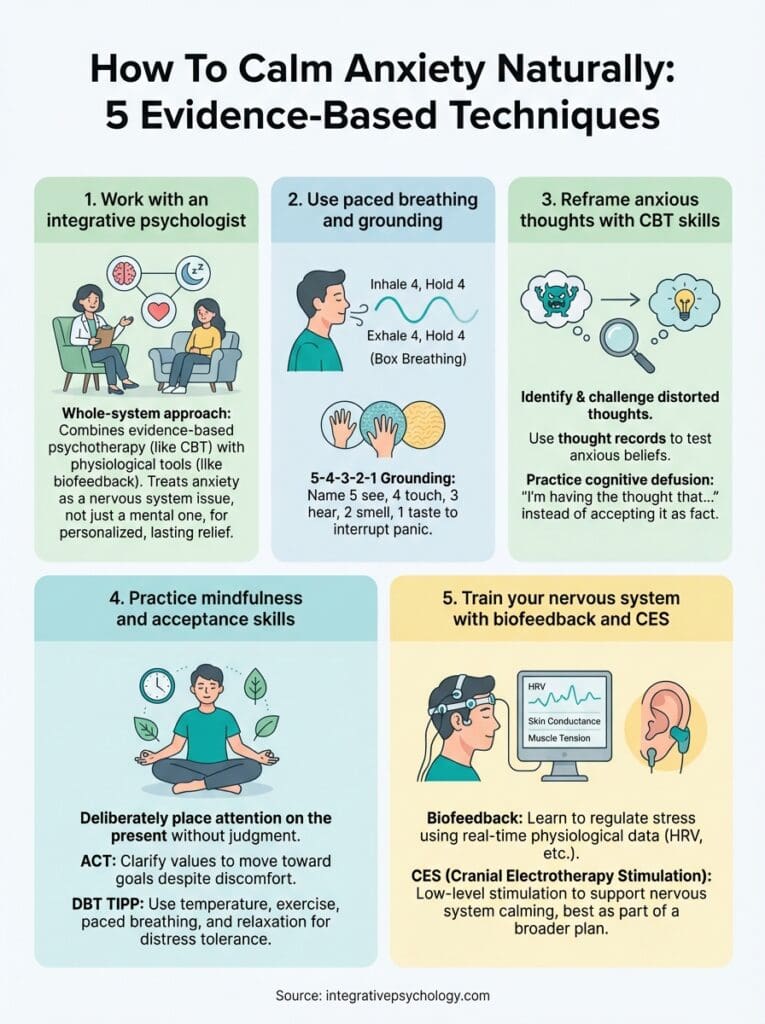
1. Work with an integrative psychologist
When you’re trying to figure out how to calm anxiety naturally, starting with a trained clinician gives you the most targeted path forward. A psychologist doesn’t just talk through problems; they assess the full picture of what’s driving your anxiety and build a treatment plan around your specific patterns, history, and goals.
What “integrative” means for anxiety care
An integrative psychologist draws from multiple evidence-based frameworks rather than locking into a single method. For anxiety, that might mean pairing cognitive-behavioral therapy with mindfulness-based interventions, or adding physiological tools when your nervous system needs more than cognitive work alone.
Treating anxiety as a whole-system problem, not just a thinking problem, is what separates integrative care from standard talk therapy.
What to expect in an intake and treatment plan
Your first session centers on gathering a complete picture: your symptoms, sleep patterns, stress history, physical health, and what you’ve already tried. From there, your clinician develops a structured, individualized treatment plan that outlines which interventions to use and in what sequence, so care is deliberate rather than improvised.
Tools a clinician can use beyond talk therapy
Beyond standard talk therapy, an integrative psychologist can bring in physiological and mind-body tools that work directly with your nervous system. Depending on what’s driving your anxiety, a clinician might draw from options like:
- Biofeedback: teaches you to regulate stress responses using real-time physiological data
- Neurofeedback: trains brainwave patterns linked to calm, focused states
- Mindfulness-based techniques: provides skills to manage strong emotions and be more present and grounded
- EMDR: processes trauma that fuels chronic anxiety
- Clinical hypnosis: targets automatic anxiety responses below conscious awareness
How to find the right provider and get started
Look for licensed psychologists and counselors who are also trained in behavioral medicine and mind-body tools alongside standard psychotherapy. Ask directly about their approach to anxiety, the specific tools they use, and whether they offer secure telehealth sessions for scheduling flexibility. At Integrative Psychology, all of our clinicians provide exactly this kind of multi-modal care for adults who want evidence-based treatment that addresses anxiety at every level.
2. Use paced breathing and grounding
Paced breathing and grounding techniques give you direct access to your body’s stress-response system without any equipment or prescription. When anxiety spikes, your nervous system shifts into a high-alert state, and deliberate breathing is one of the fastest ways to reverse that shift.
Why slow breathing calms the stress response
Your breath directly influences your autonomic nervous system. Slow, controlled exhales activate the parasympathetic branch, which signals your body to downshift from threat mode.
Extending your exhale longer than your inhale is the fastest way to activate your body’s built-in calming mechanism.
This connection is also why controlled breathing appears consistently across clinical research as a frontline tool for anyone exploring how to calm anxiety naturally.
Step-by-step paced breathing methods to try
Two research-supported methods are easy to learn and use anywhere:

- Box breathing: inhale for 4 counts, hold for 4, exhale for 4, hold for 4
- 4-7-8 breathing: inhale for 4 counts, hold for 7, exhale for 8
Practice either method for two to five minutes when anxiety starts to build, not just when it peaks.
Grounding skills for racing thoughts and panic symptoms
Grounding pulls your attention away from the anxious loop and back into present-moment sensory experience. The 5-4-3-2-1 technique works by naming five things you see, four you can touch, three you hear, two you smell, and one you taste, which interrupts catastrophic thought spirals quickly.
How to make these skills work in real life
These techniques only hold up when you practice them before a crisis hits. Build a short daily habit, even two minutes at a consistent time, so your nervous system learns the pattern and responds faster when anxiety actually spikes.
3. Reframe anxious thoughts with CBT skills
Cognitive Behavioral Therapy (CBT) is one of the most well-researched tools for anyone exploring how to calm anxiety naturally. It works by identifying the patterns that keep anxiety running and giving you practical skills to interrupt them.
How anxiety spirals through thoughts, feelings, and actions
Anxiety doesn’t appear out of nowhere. A triggering thought (“something will go wrong”) produces an emotion and feeds a physical feeling like a tight chest or racing heart, which then drives avoidant behavior that confirms the original fear. CBT maps this cycle so you can see exactly where to step in.
Core CBT techniques that reduce worry and rumination
Two techniques stand out for breaking the anxiety loop. Thought records help you examine the evidence for and against a worried prediction, replacing distorted thinking with a more accurate read. Behavioral experiments test anxious beliefs directly by doing the thing you’re avoiding and checking what actually happens.
Writing down a worried thought reduces its emotional charge faster than replaying it mentally.
How to handle intrusive thoughts without fighting them
Cognitive defusion teaches you to observe a thought rather than accept it as fact. Instead of fighting “I’m going to fail,” you label it: “I’m having the thought that I’m going to fail.” That small shift breaks the automatic link between the thought and the feeling it triggers.
Signs CBT support can help you move faster
If your worry patterns feel stuck despite self-practice, working with a trained clinician accelerates progress. A psychologist can apply structured CBT protocols to your specific triggers, adjust techniques in real time, and catch distortions you might miss on your own.
4. Practice mindfulness and acceptance skills
Mindfulness and acceptance-based approaches change how you relate to anxious thoughts rather than trying to eliminate them entirely. These tools consistently show up in clinical research as effective options for anyone learning how to calm anxiety naturally, especially when avoidance keeps the anxiety cycle running in the background.
Mindfulness basics that actually help anxiety
Mindfulness means deliberately placing your attention on the present moment without judging what you find there. For anxiety, that translates to noticing a racing thought or a tight chest without immediately reacting to it. Even five minutes of daily practice can measurably shift your baseline stress response over time.
Watching anxiety without feeding it is one of the most powerful habits you can build.
Acceptance and Commitment Therapy skills for anxious loops
ACT teaches you to stop treating anxiety as the enemy and start clarifying what you actually value, so worry loses its grip on your choices. The core skill is psychological flexibility: acknowledging discomfort is present while still moving toward goals that matter to you rather than away from fear.
DBT distress tolerance skills for spikes in anxiety
When anxiety escalates fast, DBT distress tolerance tools can help you get through the moment without making it worse. Your clinician can help you learn a number of DBT skills that incorporate mindfulness principles that can help you find a more balanced response to stressors and that can work on a physiologic level to help the body and mind feel more grounded and present.
How to build a short, realistic daily practice
Anchor your mindfulness habit to something already in your routine, like morning coffee or a lunch break, so it requires less willpower to start. Three to five minutes of consistent daily practice outperforms longer sessions you abandon after a week.
5. Train your nervous system with biofeedback and neurofeedback
For people who want to learn how to calm anxiety naturally beyond behavioral skills alone, biofeedback and neurofeedback (a type of biofeedback) offer a physiological route to nervous system regulation. Both tools work directly with your body’s stress patterns rather than through conversation alone.
What biofeedback trains and how it supports anxiety relief
Biofeedback, which includes neurofeedback, connects sensors to your body to measure signals like heart rate variability, muscle tension, brainwaves, and skin conductance. You learn to shift those readings using the real-time feedback provided (usually via , and over time your nervous system builds steadier self-regulating patterns.
Common biofeedback signals used in anxiety treatment include:
- Heart rate variability (HRV)
- Skin conductance (sweat response)
- Muscle tension (EMG)
- EEG (electrical activity of the brain)
What sessions feel like and how long it takes to notice change
Sessions for both modalities are quiet and non-invasive. Most people report a noticeable shift in their stress baseline within four to six weeks of consistent use.
Your timeline depends on baseline anxiety levels, session frequency, and how well you integrate skills between appointments.
Next steps
Learning how to calm anxiety naturally works best when you combine multiple approaches rather than relying on just one. Paced breathing and grounding give you immediate relief, CBT and mindfulness skills address the thought patterns that keep anxiety running, and physiological tools like biofeedback and neurofeedback train your nervous system at a deeper level. Each technique reinforces the others, so building even two or three into your routine makes a real difference.
Starting on your own is a solid first move, but a trained clinician accelerates your progress significantly. The licensed clinicians at Integrative Psychology use a whole-system approach that matches the right combination of tools to your specific anxiety patterns, so your care is targeted rather than generic. Whether you’re dealing with chronic worry, panic symptoms, or sleep disruption tied to stress, personalized integrative care gives you a structured path forward.
Ready to take the next step? Schedule a consultation with Integrative Psychology to start building a treatment plan that fits your life.


